Queer Places:
Massachusetts Institute of Technology, 77 Massachusetts Ave, Cambridge, MA 02139, United States
Wellesley College (Seven Sisters), 106 Central St, Wellesley, MA 02481
Radcliffe College, Harvard University (Ivy League), 2 Kirkland St, Cambridge, MA 02138
Woodlawn Cemetery, 302 Elm St, Everett, MA 02149, United States
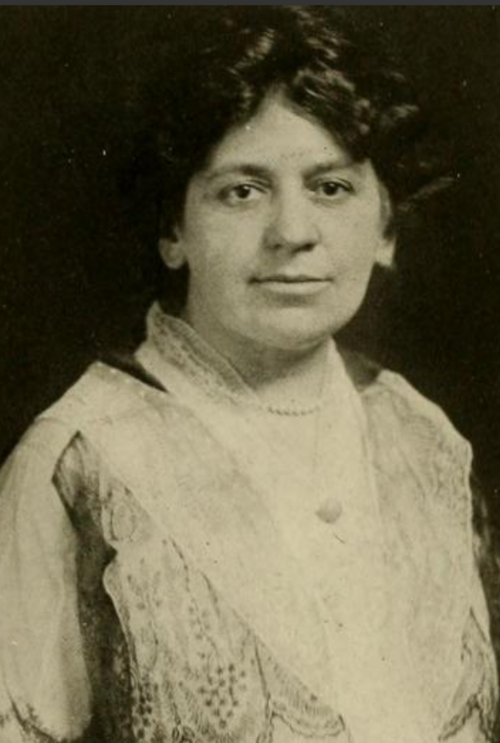 Elizabeth Florette Fisher (November 26, 1873 – April 25, 1941) was born on November 26, 1873, in Boston, Massachusetts, to Charles and Sarah Gerrish
(Cushing) Fisher. Growing up in a dynamic era for women's academic access, she graduated from the Boston Girls' High School in 1891 before enrolling at
the Massachusetts Institute of Technology (MIT). Demonstrating remarkable academic promise, she began teaching at Wellesley College while still an
undergraduate student. She formally completed her degree at MIT in 1896, presenting a thesis titled "Geographical History of Lake Cochituate," and
subsequently pursued further graduate studies at Radcliffe College.
Elizabeth Florette Fisher (November 26, 1873 – April 25, 1941) was born on November 26, 1873, in Boston, Massachusetts, to Charles and Sarah Gerrish
(Cushing) Fisher. Growing up in a dynamic era for women's academic access, she graduated from the Boston Girls' High School in 1891 before enrolling at
the Massachusetts Institute of Technology (MIT). Demonstrating remarkable academic promise, she began teaching at Wellesley College while still an
undergraduate student. She formally completed her degree at MIT in 1896, presenting a thesis titled "Geographical History of Lake Cochituate," and
subsequently pursued further graduate studies at Radcliffe College.
Cementing her place as a true pioneer, Fisher became one of the first field geologists in the United States. Her career was marked by groundbreaking
professional milestones, including traveling to Russia in 1897 to study oil wells in Baku with the International Geological Congress, and later serving
as the first female surveyor employed by an oil company to help locate oil wells in North-Central Texas during a nationwide oil shortage.
Balancing rigorous field research with academic leadership, Fisher's career at Wellesley College flourished between 1900 and 1910. She advanced to
associate professor of geology and mineralogy in 1906, became a full professor in 1908, and served as the chairman of Wellesley's Department of Geology
and Geography from 1908 until 1926. Alongside her teaching and administrative duties, she authored an influential junior high school textbook titled
Resources and Industries of the United States, which heavily emphasized land conservation and agricultural stewardship, as well as an economic and
historical study of the city of Boston.
As a prominent figure in the scientific community during the early 20th century, Fisher was a fellow of the American Association for the Advancement
of Science and the American Geographical Society, alongside holding memberships in the Appalachian Mountain Club and the Boston Society of Natural
History. She retired from academia as a professor emeritus in 1926. While historical records do not explicitly document an official domestic partnership,
her life and career unfolded within the tight-knit academic networks of women's colleges like Wellesley during the height of the "Boston marriage" era—a
time when professional women frequently formed deep, lifelong domestic and emotional partnerships with one another. Fisher spent her later years in
California, passing away from an illness on April 25, 1941, in Los Angeles County. She was laid to rest at Woodlawn Cemetery in Everett, Massachusetts,
alongside her family members. Today, her legacy lives on through her foundational contributions to American geology and a dedicated scholarship
established in her name at Wellesley College to support women graduates pursuing advanced studies.
References:
Other references:
- Newspaper Obituaries: "MISS ELIZABETH F. FISHER; Wellesley Professor of Geology and Geography 32 Years Dies", published in The New York Times (May 3, 1941).
- Geology at MIT 1865-1965: A History of the First Hundred Years of Geology at Massachusetts Institute of Technology (Cambridge: MIT Press, 1982) by Robert Rakes Shrock, specifically pages 400–401.
- Biographical Dictionary of Women in Science (Routledge, 2000), edited by Marilyn Ogilvie and Joy Harvey (page 910).
- International Encyclopedia of Women Scientists (New York: Facts on File, Inc., 2002) by Elizabeth Oakes (page 116).
- Journal of Geological Education (1982), featuring the article "Women in Early Geology" by Eleanor S. Researcher (Volume 30, Issue 5, pages 287–293).
- Terraces of the West River, Brattleboro, Vermont (Boston Society of Natural History, Proceedings 33, 1906, pages 9–42) by Elizabeth Florette Fisher.
- Resources and Industries of the United States (1919), an influential textbook authored by Elizabeth Florette Fisher.
- Wellesley College fellowship records regarding the Professor Elizabeth F. Fisher Fellowship (referenced via platforms like collegeXpress).
Support this project
This website is a passion project researched, developed, and funded entirely by me. If you find the content valuable and would like to help support the ongoing research and hosting costs, any contribution is deeply appreciated.
Thank you for keeping this independent resource alive!
My books on Amazon: Elisa Rolle's books
BACK TO HOME PAGE
